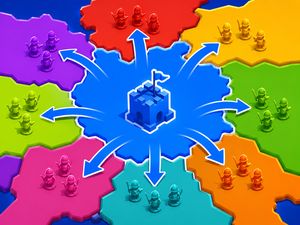
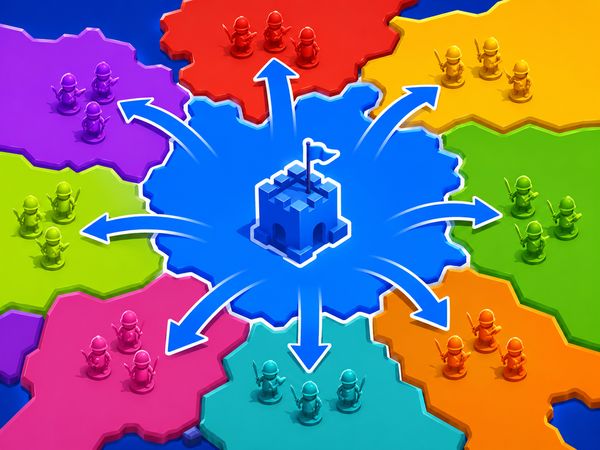
Territorial.io turns every click into a fight for space. You expand across a live map while rival players race to claim the same ground. A quiet opening can become a sudden border war within seconds. The game rewards quick judgment, not just constant movement.
Each match asks you to balance growth against danger. Push too far, and nearby players gain an easy target. Wait too long, and stronger territories may surround you. Your map position, timing, and choices shape the whole contest.
Territorial.io comes from David Tschacher and first released in 2020. It began as a browser territory-conquest project before expanding to mobile versions and custom scenarios. Play Territorial.io online now and test your first expansion against live opponents.
Territorial.io Territory Control Fundamentals
Reading the map’s pressure points
Start by studying the space around your territory. Look for open ground, nearby borders, and rival positions that could limit growth. A wide area offers room to expand, but it may also expose you to several opponents. A tighter position gives fewer directions to watch, yet leaves less room for mistakes.
Watch how the map changes after every major expansion. New borders create fresh pressure points. A rival may suddenly become your closest threat, even if that player started far away. Treat every shared edge as a possible contest rather than empty space.
Use the mouse’s Left Click to select and issue commands. Make each click with a purpose. Claiming space near a rival can challenge their route, while leaving a gap may give both players room to grow. Territorial.io rewards players who notice these shifts early.
Think in terms of pressure, not only size. A large territory still faces trouble when several opponents can reach it. A smaller territory can remain useful when its position blocks an approach. Read the shape of the map before chasing the biggest visible area.
When to expand versus hold
Expand when nearby space offers clear value and limited immediate pressure. Holding makes more sense when rivals sit close on several sides. A pause gives you time to read their movement and avoid turning one border into multiple fights. Strong play comes from switching between growth and restraint.
Do not treat every open patch as an order to move. Ask what the expansion changes. It may improve your position, close a rival’s route, or create a dangerous new edge. Choose the option that keeps your next decision simple.
Territorial.io gameplay
How endgames force diplomacy
Territorial.io stays competitive because territory alone does not settle every dispute. As players occupy more of the map, remaining space becomes harder to claim. Rival growth then creates direct pressure between territories that once had room to avoid each other.
Players must judge whether continued conflict helps them or helps another rival more. A temporary peace can change the balance between several active territories.
Diplomacy still needs careful timing. Agreeing to peace may protect one border while freeing another player to grow elsewhere. Rejecting peace may preserve pressure, but it can also keep several rivals focused on the same struggle. Read the wider map before choosing a side in the decision.
A calm border can create breathing room. It can also expose you if another player uses that time to expand. Keep watching territory changes after any peace decision.
The endgame becomes more tense because every remaining area matters. Players have fewer safe choices, and each border carries more weight. Early habits often return here: careless expansion creates weak edges, while patient positioning leaves more options.
Why near-total control matters
The documented end condition includes 99.99% territory occupation. That figure shows how complete the final contest can become. Winning requires more than leading early; you must keep control through the last available space.
Near the end, small gaps can decide the result. Check the map carefully before assuming the match has finished. A final unclaimed area or rival position may still prevent the occupation condition from being reached.
Keep your choices precise during this stage. Large early gains matter less if the final territory remains contested. Endgames reward attention, patience, and clean decisions.
Map Positioning and Opening Spawn Choices
Safe openings versus greedy openings
A safe opening starts with room to observe. You claim nearby territory while keeping your first borders manageable. This approach gives you time to understand rival positions before creating serious pressure.
A greedy opening reaches for more space immediately. It can build an early lead, but it also stretches your position across more directions. Every new edge becomes another place where a rival can challenge your progress.
Choose based on the map around your spawn. If nearby space looks open, measured growth may work well. If several rivals sit close, fast expansion can create unnecessary conflict. The best opening matches the pressure you already face.
Edges, corners, and crowded centers
Edges and corners reduce the number of directions you must watch. They can simplify your first decisions, though they may restrict future expansion. Crowded centers offer more routes and more nearby territory, but they bring rivals into contact sooner.
Do not label one position as always superior. A corner helps when it limits threats. A center helps when open routes outweigh the danger. Judge the available space, then select a plan that fits that position.
How spawn choice affects survival
Your spawn choice shapes the opening tempo. A quiet location supports careful growth, while a crowded location demands faster reactions. Think beyond the first claim and consider how many borders you may need to manage next.
Pick the position that gives you useful choices. Survival depends on having somewhere to expand, pause, or redirect pressure.
Ready for another match? Try Territorial.io right here and turn your next spawn into a deliberate plan.
Territorial.io Multiplayer Mind Games
Reading hostile neighbors
Watch nearby players before assuming their intentions. A rival who expands toward you may want direct control, or may simply need open space. Their position matters as much as their apparent direction.
Look for changes in pressure around your borders. When one player grows quickly, nearby territories may become temporary targets. That shift can pull attention away from you or expose your own edge.
Keep your response measured. Immediate aggression may help, but it may also invite a second rival into the contest. Protect your position while you learn which neighbor creates the real danger.
Forming temporary alliances
Alliances work best when both players gain time or space. A temporary agreement can reduce pressure on one border and redirect attention elsewhere. Treat it as a short-term choice, not a permanent guarantee.
Keep checking the map after an alliance forms. The balance may change quickly once one player expands. A partner today can become your closest rival later.
Punishing overextensions
Overextension creates visible pressure points. When a rival spreads too far, their position may become harder to protect. Use that moment to challenge the exposed area rather than attacking without a clear reason.
Act while the weakness matters. Waiting can give the rival time to recover or bring another player into the fight. Good timing turns their ambition into your opening.
Custom Scenario and Custom Maps
Why custom scenarios matter
The official menu highlights Custom Scenario alongside Multiplayer. That option broadens the way you approach Territorial.io. Instead of treating every match as the same opening problem, you can explore a different setup and focus on the decisions it creates.
Custom scenarios also help you study territory control without relying on one familiar map shape. Different starting arrangements can change the pressure around your position. That makes each setup useful for testing judgment, patience, and expansion timing.
Use the mode with a clear question in mind. Ask whether a position gives enough room, whether borders become too crowded, or whether a different start changes your first priority. Focused practice teaches more than random repetition.
Practice setups for specific matchups
Build practice around the problems you struggle to read. Try a setup with nearby rivals when border pressure causes mistakes. Use a more open arrangement when you want to improve expansion choices.
Repeat the same situation long enough to notice patterns. Compare a cautious opening with a fast claim, then watch how each choice changes the map.
What changes outside standard matches
Custom maps and scenarios can change the space you must evaluate. Routes, borders, and available territory may feel less familiar than in a standard match.
That unfamiliarity creates useful pressure. You must rely on observation instead of memorized habits. Enter each setup ready to reassess your plan from the first click.
Playing on Browser, Mobile, and PC
Browser access and no-download play
The browser version suits quick matches because the game stays close at hand.
Keep your clicks deliberate, especially when several borders compete for attention.
App Store and Google Play availability
The game has official listings on both the App Store and Google Play. Mobile access lets you use the same territory-conquest idea away from a browser.
Choose the store that matches your device. Then use the official listing when installing the mobile app.
Choosing the best device for long sessions
A browser suits players who want immediate access and simple setup. Mobile suits players who prefer a dedicated app. For longer sessions, choose the screen and control style that lets you read borders clearly.
PC play is also available through Google Play Games beta. That gives PC players another route to the documented mobile release.
Compare with Similar Games
| Game |
Why Similar |
| Paper.io 2 |
Both games center on capturing territory and expanding control over the map by converting claimed space into your color/territory. |
| Conquer.io |
Both games use territory conquest as the core objective, with players expanding ownership across the map while competing against others. |
🎯 Fun Facts About Territorial.io
- The official site highlights Multiplayer and Custom Scenario.
✨ Key Features of Territorial.io
- Territory conquest
- Custom Scenario
- Mobile apps
How to Play Territorial.io
Step 1: Use the game controls
Use Left Click to select and issue commands.
Step 2: Pick a starting position
Choose a map position that gives breathing room. Safer edges can help survival, while crowded centers create faster action and more danger.
Step 3: Watch your borders constantly
Keep an eye on the weakest edges of your territory. A split border can collapse faster than a single strong front.
Step 4: Exploit diplomacy when needed
Temporary peace or alliances can buy time against stronger neighbors. Use them as tools, not guarantees, because the map changes quickly.
Territorial.io FAQs
Does Territorial.io require a separate installation?
No. The browser version of Territorial.io runs on the page without a separate installation.
Is Territorial.io a good game?
It is well known for fast matches and tense map control. Whether it feels good depends on whether you enjoy competitive strategy, quick reversals, and constant pressure from other players.
Conclusion
Territorial.io is a real-time multiplayer territory conquest game built for the browser with HTML5. Released in 2020 and developed by David Tschacher, it keeps its identity focused on multiplayer competition and territorial conquest. That direct concept makes it easy to understand while keeping the central contest at the heart of the experience.
Control is equally clear: use the left mouse button to select and issue commands. With its browser platform, HTML5 foundation, and focused multiplayer mode, Territorial.io offers a direct way to engage with its defining objective. If you are ready to try a real-time territory conquest experience, play Territorial.io here on this page and get started below.
Territorial.io Game Image

No comments yet. Be the first to share your thoughts!