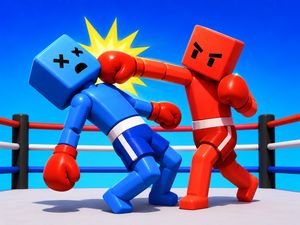
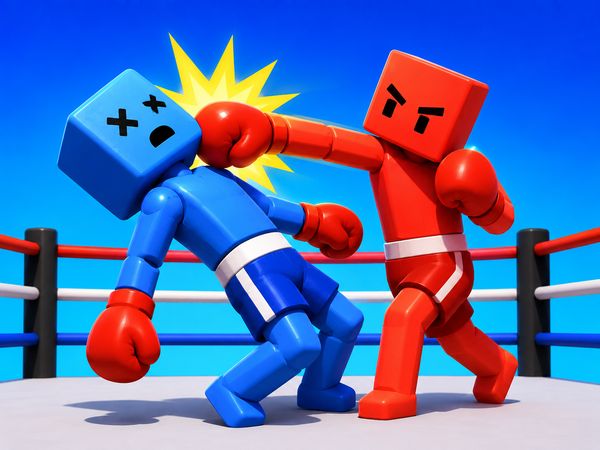
Boxing random turns every punch into a fast physics contest, where one strange jump can change the whole round. RHM Interactive keeps the controls simple, but the loose ragdoll movement creates constant surprises. You and another fighter fight for position, timing, and the next point.
The match uses a clear goal: reach five points first. Each round ends through knockout-based scoring, so every exchange carries real pressure. A wild swing might miss badly, or it might send the other fighter down at the perfect moment.
Play Boxing random online when you want a quick local rivalry with almost no controls to learn. Start here, watch how the fighters move, then press at the right moment instead of mashing. The best wins often come from calm timing rather than perfect-looking punches.
Boxing random matches: the core win condition
Racing to Five Points
Boxing random uses a first-to-five scoring rule. The player who reaches five points first wins the match. That target gives every round a clear purpose, even when the fighters bounce, twist, and swing in unusual ways.
A knockout decides the point. Win one round, and your score moves closer to five. Lose one, and your opponent gains ground immediately. The system keeps the match moving because neither player needs to track a long health bar or wait through a drawn-out exchange.
Think of the score as a pressure meter. At 0–0, you can test movement and learn the current space. At 3–0, the player behind must take more chances. At 4–4, one clean finish decides everything. That final point can make a normally funny physics moment feel extremely tense.
Do not treat early rounds as disposable. They reveal how far your fighter jumps, how quickly attacks reach, and how the arena affects contact. Use that information before the score becomes tight. A small adjustment after round one can shape the rest of the match.
What Ends a Round
Each round ends when one fighter suffers the knockout that awards the point. Ragdoll motion makes that finish less predictable than a standard boxing animation. A fighter may lean too far, lose balance, or collide at an awkward angle before the game settles the result.
Watch the whole exchange, not just the fist. A jump, body swing, or falling movement can create the contact that matters. When the knockout arrives, the round is over and the score changes. Reset your attention quickly, because the next round starts with a fresh chance to respond.
Reading the Scoreline
The score tells you how much risk makes sense. With a narrow lead, protect your position and wait for a clear opening. When you trail by several points, press more often, but keep your timing deliberate. Reaching five matters more than producing the flashiest hit.
One-button controls and Player timing
Player 1 Inputs
Player 1 uses W for the main move or jump input in two-player browser play. The key also controls the game’s one-button rhythm: press, watch the motion, then decide when to press again. Timing matters more than learning a long command list.
The verified movement keys also include A for moving left and D for moving right. Use them to adjust your fighter’s place before the next exchange. A short move can close a gap, while a quick shift can stop your character from drifting past the opponent.
Do not hold W without watching the result. A press changes your fighter’s motion, and ragdoll movement may carry that action farther than expected. Tap with purpose near the opponent, then let the character settle enough for you to judge the next contact.
Player 1 should watch the opponent’s body position first. If the rival rises into a jump, wait for the descent or move into the landing space. If the rival drifts away, use AN or D before committing to another W press.
Player 2 Inputs
Player 2 uses Arrow Up for the main move or jump input. That keeps the two-player setup easy to remember: W belongs to Player 1, while Arrow Up belongs to Player 2. The same timing rule applies. Press when the opponent enters a useful range.
Player 2 also has Arrow Left for moving left and Arrow Right for moving right. Small direction changes help line up a swing without forcing a reckless jump. Keep watching the fighter’s balance, since the loose physics can turn a simple movement into an unexpected lunge.
Single-Player Versus Two-Player Feel
Single-player play puts the opponent’s timing under CPU control. That creates a different rhythm from local multiplayer, where another person reacts instantly and may change tactics between rounds. Against the CPU, study repeated movement. Against a friend, watch the fighter and the person controlling it.
Boxing random and its changing round rules
Random Arenas and Fields
Some documented browser versions describe changing rounds and arenas between matches. That change keeps one familiar control scheme from feeling completely fixed. A space that gives you a comfortable approach in one round may demand a different starting movement in the next.
Look at the available field before pressing. Check the distance between fighters, the open space around them, and how much room a jump seems to have. You do not need a new button for each arena. You need a new first decision.
Start cautiously when the field looks unfamiliar. A single W or Arrow Up press can show how quickly both characters move through that space. Then use A, D, Arrow Left, or Arrow Right to correct your position. Let the arena reveal its rhythm before you chase a knockout.
Changing arenas also makes old habits less reliable. A move that worked from the center may fail from another starting place. Treat each round as a short test, then keep the useful information for the next exchange.
Changing Opponents and Outfits
Some versions also describe changing opponents and outfits between matches. These visual changes help each match feel less identical, while the main contest stays focused on physics, spacing, and scoring.
Do not judge a fighter by appearance alone. The reliable information comes from movement on the field. Watch how the character jumps, swings, and lands. Keep your plan flexible until you see the current opponent move.
Why Adaptation Wins
Adaptation wins because the controls stay simple while the situation changes. Read the arena, identify the opponent’s approach, and adjust your next press. That small pause often beats a fast but careless attack.
Try Boxing random right here and see how quickly the score changes when your timing improves.
Ragdoll physics in close-range fights
Swinging Into Contact
Ragdoll physics gives Boxing random its wildest moments. Characters move with loose, unstable physics instead of rigid boxing animation. A swing may lift the body, twist the arms, or send the fighter forward at an odd angle.
That motion changes how you read an attack. Do not wait for a perfect punch pose. Look for the moment when your fighter’s body moves toward the opponent. A messy collision can still create the knockout that ends the round.
Close range rewards patience. Press too early, and your fighter may rise before contact. Press too late, and the opponent may pass underneath the swing. Let the bodies move, then choose the input that brings your fighter through the best contact point.
Jumps matter as much as swings. A rising fighter can miss completely, while a falling body may connect from an awkward angle. Learn to recognize both phases. The strongest hit often comes during a return to the ground, not at the start of the jump.
Why Positioning Matters
Spacing controls the quality of every press. Stand too far away, and the attack may end before reaching the rival. Stand too close, and both fighters can tangle before either player gains control.
Use small left or right movements to shape the next exchange. Player 1 can use AN and D, while Player 2 uses Arrow Left and Arrow Right. These inputs help you enter range without spending the whole attack on forward movement.
Position also affects recovery. A fighter near the opponent may keep pressure after a missed swing. A fighter drifting away gets more room to reset. Watch where the body will land before choosing another jump.
When Messy Motion Helps
Unstable movement can create useful contact. A strange lean may put your fighter below an incoming swing. A sideways fall may carry the body into range. Stay alert when the motion looks wrong; the awkward angle may become your best opening.
Playing for control instead of panic
Approach Without Overcommitting
Approach in short decisions. First, measure the gap. Next, choose whether to move or jump. Then watch the opponent’s response before pressing again. This rhythm keeps you involved without throwing your fighter into every possible collision.
Use direction to improve your starting position. Player 1 can move with AN and D, while Player 2 can use Arrow Left and Arrow Right. A small adjustment often creates a better attack than an immediate W or Arrow Up press.
Keep the five-point goal in mind, but do not rush toward it blindly. A lead gives you room to wait. A deficit asks for action, yet panic still wastes chances. Make the opponent react first whenever the distance gives you time.
Close-range fights reward controlled pressure. Move near the rival, pause long enough to read the body, then press into the likely path. This approach feels slower, but it creates cleaner chances inside the game’s unstable physics.
Use Small Windows
Small windows appear when the opponent lands, drifts sideways, or swings past your body. Press during that brief gap instead of attacking from a random distance. Your goal stays simple: put your fighter’s motion where the opponent must travel.
Do not chase every opening. Some windows close before your character can reach them. Choose the ones that match your current position, then let the next exchange develop naturally.
Recover After Misses
A missed attack does not automatically lose the round. Stop pressing for a moment and watch the landing. Use a direction input to regain space, or hold your position if the opponent moves too close.
Recovery starts with seeing where your fighter ends up. Once the body settles, make one clear choice. Resetting calmly can turn a bad swing into a fresh defensive position.
Compare with Similar Games
| Game |
Why Similar |
| Basket Random |
Both use intentionally unpredictable, physics-driven controls where each match is decided by simple movement and timing. |
✨ Key Features of Boxing random
- Ragdoll movement
- First to 5 points
- One-button controls
- Single-player mode
- Two-player local mode
How to Play Boxing random
Step 1: Use the game controls
Use W to move or jump for Player 1. Use A to move left for Player 1. Use D to move right for Player 1. Use Arrow Up to move or jump for Player 2.
Step 2: Start a round
Load the game and enter a match in either solo or two-player mode.
Step 3: Use the correct control
Press W for Player 1 or Up Arrow for Player 2 in the documented two-player build.
Step 4: Time the hit
Press as your boxer leans into range, since sloppy presses often whiff.
Step 5: Chase the knockout
Focus on landing the clean contact that awards the point.
Step 6: Track the score
Keep pressure on the scoreline and play toward 5 points first.
Step 7: Adjust to the next round
Expect the field, opponents, or round setup to shift and change your spacing.
Boxing random FAQs
What are the basic controls for Boxing random?
Browser keyboard: W — move or jump for player 1; A — move left for player 1; D — move right for player 1; Arrow Up — move or jump for player 2; Arrow Left — move left for player 2; Arrow Right — move right for player 2.
Does Boxing random require a separate installation?
No. The browser version of Boxing random runs on the page without a separate installation.
Who made Boxing random?
The game is listed by RHM Interactive on Google Play, and the related store and portal listings point to the same developer identity. That makes RHM Interactive the documented developer name for this release.
Conclusion
Boxing random turns boxing into a lively physics-based ragdoll experience where loose, unstable movement makes every hit, jump, and swing unpredictable. The messy motion is part of the appeal, demanding timing and spacing rather than precise combos. With simple keyboard inputs, Player 1 uses W, A, and D, while Player 2 uses the Arrow Up, Arrow Left, and Arrow Right keys.
Available in singleplayer and multiplayer, Boxing random keeps each match focused with its clear 5 Score First goal: the first player to reach five points wins. That direct scoring pressure gives every exchange meaning while preserving the entertaining chaos of ragdoll physics. Whether you want to test your timing alone or challenge another player, jump into Boxing random and play right here on this page.

No comments yet. Be the first to share your thoughts!